By now, everyone knows that AI stands for Artificial Intelligence and that it is causing both excitement and alarm. It is one of the technological subjects that interests me, but I will resist the temptation to waffle on about how it works, and other aspects that most people are just not bothered with. Instead,
I want to focus on two things: what everyone needs to know about AI, and then what might interest Christians in particular.
Some things that should concern all of us
A much-lauded positive result of applying AI is that it frees humans from performing low-level or repetitive tasks, thereby creating more time to be creative and innovative. In First-World countries with low unemployment rates, this could be a positive development. However, in Third-World countries with high unemployment rates, perhaps it is not.
I live in a Third-World country where the expanded unemployment rate is over 42%. The total population, including an estimate of unregistered immigrants, is about 65 million. So, that means that about 28 million people do not have employment! So, for millions of people, the fact that AI is doing the routine and repetitive work is not good news.
To exacerbate the situation, according to some research findings, a large percentage of the country’s total population, and not just the unemployed, is estimated to be incapable of facing the cognitive challenges of a rapidly increasing AI-driven economy.
So, what is to be done? For starters, where precision and accuracy are not paramount, the private sector could forgo the additional profits that come from employing AI to do low-grade tasks. That is highly unlikely because businesses in South Africa need to compete with overseas companies if they are to survive. Secondly, both private and public sectors could upskill as many low-IQ education people as they can, and this is where AI can help a lot. AI is great for designing and implementing educational and skills training programmes. This would require massive and rapid organisation, funding and expertise, so this too is very unlikely to happen in the near future. Private home owners could also help by employing people with cognitive challenges to work as domestic helpers, gardeners and so on, and responsibly help them get by if they can. Some people who live in large houses often employ the minimum number of domestic helpers on the grounds that they can’t afford it, yet they eat out frequently and go on expensive holidays. Perhaps we should all rethink where we stand on this? Even if there was an immediate and country-wide change of heart, this strategy would be a drop in the unemployment ocean.
How we all should use AI at a personal level
How not use AI, in my opinion, is to set it tasks and allow it to do our thinking for us. This is ethically questionable and also detrimental to us.
A recent study was conducted by a top American University, which tracked 54 participants writing essays over four months. They were allowed to use AI as much as they wanted. They then compared the results to a control group that did not use AI and found that the AI-assisted group displayed lower brain activity, particularly the mental activity linked to creativity and memory. Moreover, the reports claim that there was an 83% inability to accurately recall what they had written! Another 2025 study of 666 participants found a marked correlation between frequent AI use and critical thinking scores. Younger users showed higher dependence and worse performance.
The study did not prove permanent brain decline, but that the danger of ongoing dependence on AI is nevertheless real.
Ethical Considerations
A question that our experts and legislators are currently grappling with is ‘To what extent can ‘creators’ claim ownership or take credit for something they produce with the help of AI?’ I write a lot, so I will use that as an example. On one end of the spectrum is the use of spelling and grammar checkers in products such as Microsoft Word or Grammarly (forms of AI). I am both dyslexic and a lousy speller, so for me these aids are essential. They don’t save me time because I have to make so many corrections, but they save face and reputational damage. These aids are as necessary to me as audio-to-text applications are to some physically impaired people. I do not regard these aids as presenting an ethical problem. What is more, I have no problem with using AI to scan my work for tone or content that could cause offence or be misunderstood. I have, on occasions, also asked AI to adapt my writing to be better understood and related to by certain age groups or types of people. It is at this point that things get a little dodgy for me.
The broader societal impact of AI
I have recently watched several AI experts talking about the future effects of AI on society. Some have waxed lyrical about the hugely positive influence AI is having in the fields of medicine, pharmaceutics, and so on, where it performs admirably in helping doctors diagnose more accurately and assisting surgeons in delicate and difficult procedures. It helps in developing aids for the disabled, finding new cures and seems to have many other clear benefits to humanity. I am sure they are right about this, and we will all benefit from the rapid advances being made. On the other side of the coin are the equally rapid AI-led advances in lethal arms development, narcotics creation, and techno-crime of every sort. AI is also being used to trick us into giving access to our banking accounts! I get about 5 emails or SMS attempts to defraud me every day, as well as sporadic telephone calls trying to get me to allow access to my bank accounts! Of late, they have been getting sophisticated and deceptive with the use of AI, making them even more convincing.
Beyond financial deception, there is a more subtle and troubling effect of AI that impacts our mental and spiritual well-being. At this level, the impact of AI, as I experience it, is almost entirely negative.
The other day, I stumbled on a YouTube video where a so-called professor of applied mathematics claimed to have had a near-death experience where Jesus gave him five warnings to the world. Strangely enough, he was presented as an avowed and vigorous atheist. He said that these warnings would be observed by everyone around the world and would all occur in January 2026.
This example is not an isolated incident, but part of a rapidly growing pattern. Why do people do this? The main reason is no doubt that they get paid money by advertisers and media companies, depending on the number of views they get and the duration of each view. Also, it is easy to get a suite of AI applications that produce high-quality and potentially convincing content. One person can produce up to ten of these videos a day by using AI! To make matters even worse, these videos can sow fear or morbid satisfaction for some folks – some even call it ‘fear-porn’, can you believe it?
A global concern
Some of what I have described so far may sound like a uniquely South African crisis, but the same dynamics are beginning to surface globally – and at a scale that could affect every nation.
Some of the same AI experts I have mentioned watching also debated a big concern for all thought-leaders, politicians, and top business executives. If AI does away with as many jobs as it seems it will, then how do the jobless survive? The apparent answer is that the governments of the world will have to pay a universal income allowance to everyone on the planet- a sort of dole or social grant on steroids. So apparently, we will all be able to get along just fine without earning a living. But here is the thing. Who would pay for these multi-gazillion-dollar grants? Why the governments, of course. And where would they get the money to do this? Well, in taxes from the tech giants, who make obscene profits from producing the AI that is the cause of the problem. It sounds a bit like a snake-eating-its-own-tail metaphor. This whole scenario raises a question that is not merely financial, but profoundly human and spiritual.
Beyond the economic questions lies a deeper human issue – one that goes far beyond employment figures and government policy.
How would we all retain a sense of dignity, worth, self-identity, and self-respect? Why would we want to earn university degrees? How would we fill the hours of each day?
The answers from the experts were that, as the transition from labour to AI will take place gradually, companies, universities, and the like would have time to restructure themselves and reengineer their systems and reward mechanisms. However, AI is developing with alarming speed, Quantum computers are coming online to push AI to even greater achievements, and AI itself is on a fast track to becoming better in every field than almost all humans. It may not be long before not only the simple and repetitive jobs will be done by AI, but almost ALL jobs will be done at never-before-seen levels of competence. This is not imaginative thinking. Elon Musk has made the statement that Grok AI is already able to solve approximately 40% of problems on multi-disciplinary PhD-level benchmark tests.
Something mysterious to consider
In an article like this, I have to limit both scope and depth because of the complexity of the subject, but here is a theological reflection to make it even more ‘deep and complex’. There are two well-known passages in the Old Testament, one in Isaiah and one in Ezekiel, that most Evangelical scholars agree are addressing the evil spiritual being motivating the two pagan Kings who are the initial subjects of the prophecies.
Isaiah 14:12-14 reads, “How you have fallen from heaven, O morning star (Lucifer), son of the dawn! You have been cast down to the earth, you who once laid low the nations! You said in your heart, “I will ascend to heaven; I will raise my throne above the stars of God; I will sit enthroned on the mount of assembly, on the utmost heights of the sacred mountain. I will ascend above the tops of the clouds; I will make myself like the Most High.””
Ezekeal 28:12-16 reads, “‘You were the model of perfection, full of wisdom and perfect in beauty … You were anointed as a guardian cherub, for so I ordained you. You were on the holy mount of God; you walked among the fiery stones. You were blameless in your ways from the day you were created till wickedness was found in you … So I drove you in disgrace from the mount of God, and I expelled you, O guardian cherub, from among the fiery stones. Your heart became proud on account of your beauty, and you corrupted your wisdom because of your splendour. So I threw you to the earth; I made a spectacle of you before kings.”
Lucifer, Satan, the fallen Archangel, wanted to be like God and rule the creation with no accountability to the one true God. This has remained his burning ambition to this day. Now consider what he would have to counterfeit to persuade the people of Earth to believe that he is God, not the Lord Jesus Christ, who is the true ruler of creation.
Well, what are the defining attributes of God? His Omnipotence (all-powerful), Omniscience (all-knowing), Omnipresence (everywhere), and Omnibenevolence (perfectly good). He would also have to seem able to create life. So, if he could produce a new form of ‘life’, never seen on Earth, a digital life, then he could perhaps persuade people to believe that he was a true creator.
An Artificial Superintelligence (ASI) could be the basis for a claim to Omniscience. The AI developers are competing fiercely with each other to produce just such a god-like AI. Now pair this with Quantum computing and the World Wide Web (internet), and you have a deceptive claim to Omnipotence and Omnipresence. The really tricky one for him to pull off would be to convince people that he was perfectly good (Omnibenevolent). Well, Paul addresses this in 2 Thessalonians Chapter two – here is an edited version of verses 1-12: “Don’t let anyone deceive you in any way, for that day (the second coming of Jesus) will not come until the rebellion occurs and the man of lawlessness is revealed, the man doomed to destruction. He will oppose and will exalt himself over everything that is called God or is worshipped, so that he sets himself up in God’s temple, proclaiming himself to be God … The coming of the lawless one will be in accordance with the work of Satan displayed in all kinds of counterfeit miracles, signs and wonders, and in every sort of evil that deceives those who are perishing. They perish because they refused to love the truth and so be saved. For this reason, God sends them a powerful delusion (The Great Deception) so that they will believe the lie …”
The powerful delusion will include the lie that Satan is actually absolutely good and has their best interests at heart. AI could certainly demonstrate that attribute … for a while.
OK, enough Christian conspiracy theory. I include it here mainly to point out some possible spiritual implications of something like ASI. I plan to include this idea when I write on the forces driving AI development and deployment in 2026-2028.
Conclusion
AI is mysterious and quite awesome, even as it is now. It could be a power for great good or evil. It will undoubtedly change our lives radically and rapidly. One of the greatest challenges to Jesus followers is ‘Will we depend on the Lord or on AI? Will we derive our sense of dignity and worth from Jesus or Artificial Intelligence? Will we believe the lie or hold to the truth?”‘
So, now all I need to do is run this article through my favourite AI and ask it to rewrite the parts that need improving … nah, I don’t think so 😊
Postscript
We have just entered 2026, a year full of hope, fear, and … change. Some of the change will no doubt come from domestic and political economics and politics, but there will certainly be huge technological changes. Artificial Intelligence leads the charge into 2026, bringing with it the urgent need for sober reflection and deep spiritual renewal. Therefore, I plan to write a series of articles covering topics like:
- The need to be aware of the implications of Artificial General Intelligence
- The problem of blindness to the exponential nature of change in our day
- What Jesus said about the times we may well be living in
- The church of Acts 1-8 as a guide to church and Christian life today
- Symbols and apocalyptic imagery in the book of Revelation
For those who like to listen more than read
I usually produce an audio/podcast of my articles two weeks after I publish them, but this time things are different. Even if you don’t usually listen to my TruthTalks, click on the audio link below for what, for most of you, will probably be a new experience. It is two AI-generated characters, a man and a woman, discussing this article in what they call a Deep Dive. All I did was upload the article to Google NotebookLM, and AI did the rest.


3 thoughts on “AI – The Good, the Bad, and the Mysterious”
Your uploading of the article to an AI link and then listening to how AI converted your article into a discussion is mind blowing and certainly highlights what we, as humans, are facing. Our awareness and need to walk and communicate very closely with God at all times is essential in this “new world order”!
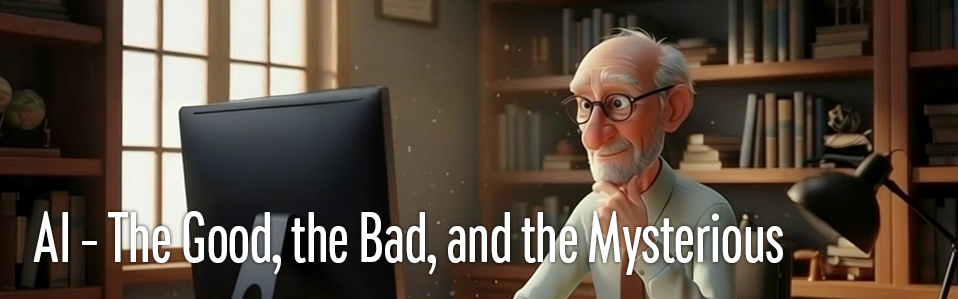
Whatever else AI does, it cannot be complimented for the new picture we see of the author of so many wonderful articles we benefit from!
🙂