My last article was a gentle introduction to this new series, ‘AI In Our Future’. Before I introduce two key concepts, I’d like to share a story with you:
When the World Moved On
He stared at his hands — steady, capable, but suddenly useless. “Good with numbers,” his retrenchment letter had said, as if that were an outdated technology. Over coffee gone cold, he tried to open a spreadsheet he’d made for job leads, but the screen’s blue pulsing notifications reminded him that the world no longer needed clerks.
His wife Nomsa lingered by the window. Her phone rested untouched on the sill, vibrating occasionally with messages from former colleagues. She hadn’t replied all week. It wasn’t shame — it was something deeper, a quiet unravelling of who she believed herself to be. For years, reports, deadlines, and mentoring younger staff had been her rhythm of purpose. Without them, time felt wide and formless.
From the corridor came the sound of Amahle’s school shoes tapping on the tiles. She was sixteen. “They say the new maths tutor at school’s an AI,” she said, slipping toast into her mouth. “It marks our papers in seconds.” She laughed without irony, but there was an anxious tremor in her voice. “At least it can’t get retrenched.”
Nomsa forced a smile, but the words landed like stones. At the far end of the kitchen, their son Liam sighed over his laptop. His graduation photo still hung above the counter, showing a young man in robes, eyes full of untested promise. Now, he was writing proposals for potential clients who preferred the “AI-hybrid freelancer plan.” Deep down, he wondered if he was already obsolete.
That evening, the house seemed heavier. Job portals glowed unanswered. A half-cooked supper congealed on the stove. David finally spoke. “You know,” he said quietly, “I used to think my work meant I mattered — keeping order, balancing accounts, being needed. Now …” His voice trailed off. “Now I don’t know what I am.” Nomsa placed a hand over his. “Maybe that’s what we need to find again — not the jobs, but what we are without them.”
The couple sat in silence, not hopeless, but hollowed, waiting for meaning to return, or for faith to remind them that dignity is not a job title, and worth is more than a login. (AI-generated)
That’s a rather sad story, isn’t it? Unfortunately, it’s already painfully real for so many people in my country, South Africa. Right now, most unemployment isn’t because AI has taken jobs – it’s because of our struggling economy and difficult socio-political situation. But in the very near future, AI is likely to become a major driver of joblessness. The story is also a graphic summary of the rest of this article.
Now, perhaps you are thinking, “Ah yes, Chris, I know something about AI, and I don’t think things will be much different to when computers came along – two jobs created for every one lost.” Well, maybe. But there’s that troublesome word: maybe. Maybe this will happen, or maybe that, or maybe something else entirely… or maybe we just don’t have the right mental tools for assessing what all these ‘maybes’ really mean.
So the first topic I want to address is something I’m calling Exponential Ectopia.
Exponential Ectopia
“Say what now?” I hear you ask. Well, you shouldn’t have heard that term before because I’ve just invented it (as far as I know). ‘Ectopia’ is a condition, when applied to an eye, where the lens is misaligned, commonly causing short-sightedness. ‘Exponential’ means getting faster and faster. Put them together, and you’ve got our collective problem: we’re short-sighted about how rapidly things are accelerating.
Here’s the thing: we are practically hard-wired for a way of thinking about the future. We make an estimate based on what happened before and project it forward.
We subconsciously construct a mental graph where the angle shows a rate of change we’re used to. Trouble is, change no longer happens in that nice, steady, linear way — it’s exponential. The rate of growth doesn’t stay constant; it doubles, then doubles again.
Let me give you a concrete example: There’s a dam near where I live that became infested with Kariba weed. On day one, there were just a few plants bobbing about. By day two, they were appearing in different places. By day 12, the dam was a quarter full of them. By day 16, it was half full. And by day 20? One hundred per cent of the dam was covered in floating weeds! The coverage doubled every four days.
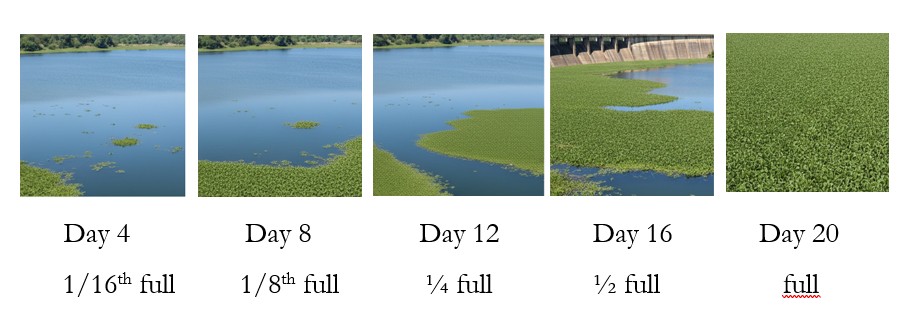
Now, if that’s hard enough for us to wrap our heads around, here’s the kicker: AI and its related technologies are doubling in capability every seven months. Their rate of exponential growth started small and seemed to have a nice, gentle slope. But like those weeds, the rate of change took off, and now we’re in what I can only describe as an exponential tizzy, with little capacity to comprehend what’s actually happening.
So when you catch yourself thinking, “AI can’t possibly be changing that fast; I’m sure we’ll have years to adapt,” please think again! It is like looking at the Kariba weed in the dam on day sixteen and thinking, “Well, it’s taken 16 days to get half choked up, so we still have over two weeks to find a solution.” Unfortunately, you would be totally wrong, because in four days the dam will be full of weeds! Exponential Ectopia leads to complacency and a dangerous lack of preparation. It’s far better to err on the side of realistic expectations, even when it’s a disturbing prospect. Better to recognise that the light at the end of the tunnel might actually be a rapidly accelerating train and prepare to jump, than to be caught unawares.
Beyond this perceptual problem, there’s another psychological challenge we need to be aware of: Change Trauma.
Change Trauma
Here’s the truth:
we simply don’t know with any certainty whether Artificial Superintelligence will bring good or bad changes to us and our society. What we do know is that change – whether positive or negative – can be deeply traumatic when it happens too quickly or too intensely for a person or community to process and adapt.
We’re pretty certain that AI is bringing unimaginably rapid change into our world. So we can be equally sure that there will be real trauma involved. What does this look like? Well, a few things:
- First, there’s the disruption to our sense of stability. Change destabilises our routines, our identities, and our expectations — basically, everything we’ve built our daily lives around.
- Then there’s the feeling of losing control. Events start to feel like things happening to us rather than developments we’re navigating alongside. We lose our sense of agency.
- Our brains also experience cognitive overload. Too many new variables hitting us almost simultaneously exceed our working memory and our capacity to adapt. This leads to confusion, anxiety, or mental paralysis — we just freeze and end up doing nothing positive.
- Finally, there’s a mismatch stress. When what’s familiar and what’s suddenly required are miles apart, our brains trigger stress responses similar to trauma: fight, flight, or freeze.
Having some idea of what’s coming down the tracks, and at what speed, helps us both to cope and think clearly about how we should respond. Can you imagine the irony? Superintelligent AI turns out to be genuinely beneficial, but we’ve shredded ourselves mentally because the speed and magnitude of the changes were just too much for us to handle.
Conclusion
But here’s an even greater irony, one that troubles me deeply: Jesus-followers suffering unnecessarily during times that could actually be productive and faith-building. Think about it. Jesus told His disciples, and that includes us, that he will never leave or forsake us, that he’ll be with us until the very end of the age, and that we shouldn’t fear because he has overcome the world.
These aren’t just nice-sounding verses for quieter times. They’re solid promises for exactly these kinds of moments. I’d encourage you to read passages like Matthew 28:20, Hebrews 13:5, Romans 8:38–39, and 1 Peter 5:7. Let them sink in. Let them become not just familiar words, but anchors for your soul.
Throughout this series, I’ll be giving you glimpses into what we can reasonably expect regarding AI and some idea of the timelines involved. More than that, though, I want to bring you practical wisdom that will help build your confidence and strengthen your faith for the times ahead. Not a flimsy optimism based on hoping technology works out, but a deep hope rooted in the One who remains sovereign over every algorithm and every acceleration.
God bless you, my friend
As with my last article, here is a debate by tw0 AI characters. Please drop me a line if you find this approach helpful or unhelpful.
Podcast: Play in new window | Download


